I have always been passionate about telecommunications, and the implicit idea of achieving a “connected world”, wired or wireless, where information flows from one end of the globe to the other, regardless of the location and the native way in which each country, city or region tends to communicate. But in the face of this idealisation of a historically and recurrently connected world, there are problems of understanding in this communication. Whether it is because the language is different, because different alphabets or writing is used, or because culturally the rules of language use and the way of communicating differ from continent to continent, the reality is that global communication is a challenge that we continue to face today.
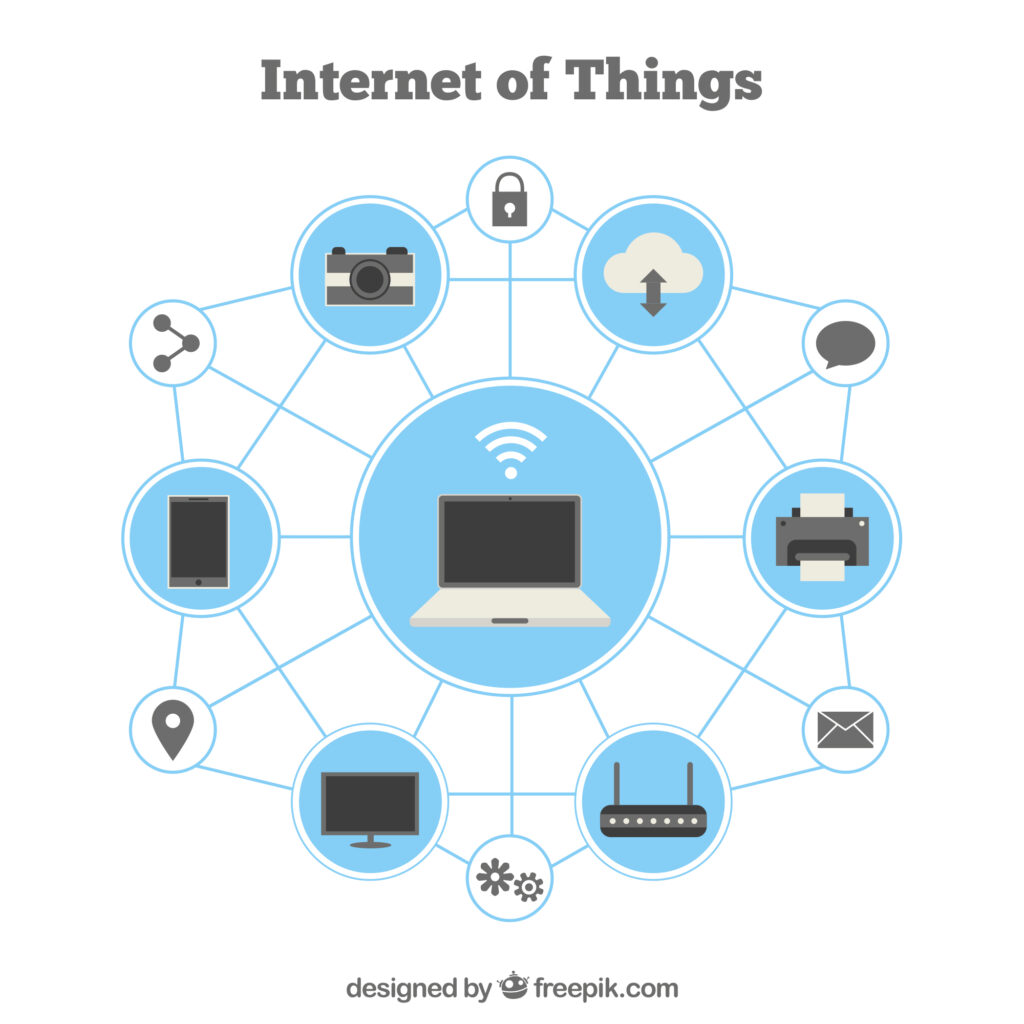
In the era of digitisation and the Internet of Things (IoT), where large volumes of data are now being collected, stored and processed, problems in the communication and unique representation of information are once again becoming apparent. It will be difficult to find data capture devices (from different manufacturers) that provide information using the same format, or that answer using the same question. Such is the problem that there are disciplines, including telematics, that focus on defining and specifying standard communication protocols that apply to different domains. But what if we want to communicate different domains? Despite the existence of standards, the problem persists. We are faced with a Digital Tower of Babel, where the heterogeinity of protocols, representation formats, communication rules and standards once again makes understanding between systems and solutions difficult.
To solve this problem, and of course, in the military and technological sphere, the concept of interoperability was born, understood as the ability of the armed forces of different nations to collaborate efficiently through the integration of systems and communications. This interoperability approach was later adopted by other sectors, such as the Information and Communications Technology (ICT) sector, with the development of systems that required efficient and conflict-free information sharing between different devices and platforms. In this ICT context, interoperability is understood as the ability of different systems, devices or applications to comunicate, exchange and use information effectively and coherently.
“Interoperability. Understood as the ability of different systems, devices or applications to comunicate, exchange and use information effectively and coherently.”
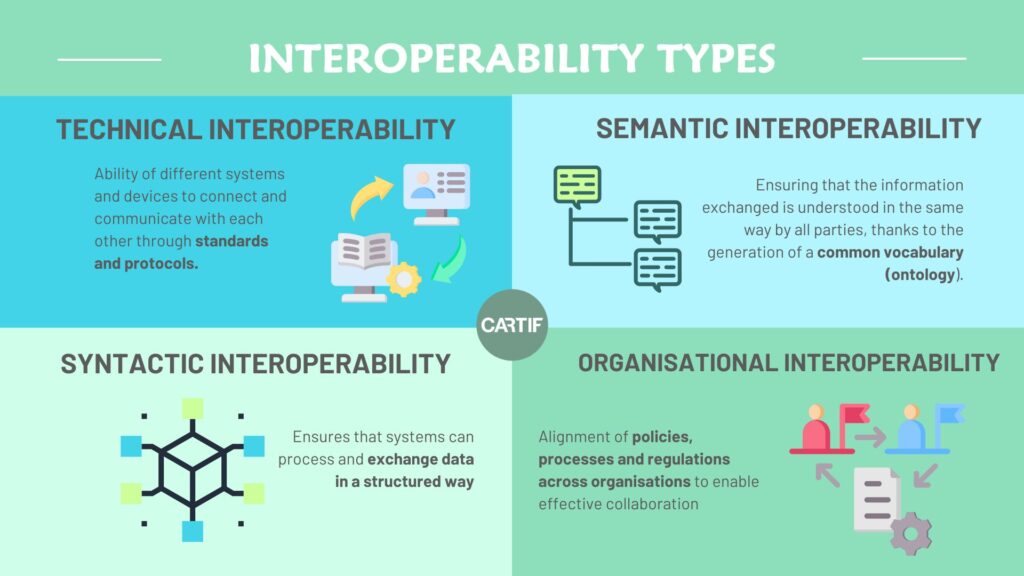
To achieve this interoperability between heterogeneous systems, i.e., systems that speak different languages and represent the information in different ways, we need to cover several dimensions, each focusing on a different aspect of communication and data exchange between systems:
Technical interoperability refers to the ability of different systems and devices to connect and communicate with each other through standards and protocols. This includes hardware, software, networking and communications compatibility.
Semantic interoperability is responsible for ensuring that the information exchanged is understood in the same way by all parties, thanks to the generation of a common vocabulary (ontology). It is about ensuring that systems interpret data with the same meaning, regardless of how they are structured or labelled.
Syntactic interoperability ensures that systems can process and exchange data in a structured way, i.e., that the same data formats and structures, such as XML or JSON, are used.
Organisational interoperability involves the alignment of policies, processes and regulations across organisations to enable effective collaboration. It encompases governance arrangements, security policies and data management.
One of the sectors that will benefit greatly from these interoperability solutions is the building sector, where digitisation and information exchange at all stages of the life cycle offers a springboard for development and competitiveness. Here, the creation of intelligent buildings, highly monitoring and able to anticipate the needs of their users thanks to digitisation and advanced data processing, alowws forbuildings that contribute to the goals of efficiency, decarbonisation and sustainability. In this context, interoperability solutions allows the diverse energy systems (such as lighting,HVAC, air conditioning, etc.) to work together, sharing and processing data seamlessly, regardless of manufacturers or platforms. This helps to optimise building management, reduce costs and improve energy efficiency by enabling systems to work as an integrated ecosystem.
At CARTIF we have been working for more than a decade on energy efficiency projects where interoperability enabling technologies, both technical and semantic, are a key element for obtaining smart, open and highly replicable solutions. Projects such as DigiBuild, DEDALUS and BuildON are examples of how these technologies facilitate the creation of smart and sustainable buildings.
What does it mean the tears of Alon Sharma during the closure of the COP26 of Glasgow?
Only one week separate us from the celebration of the last Conference of the United Nations about the Climate Change (COP26), and in my mind has been recorded the downcast image of Alok Sharma, president of the COP26, during the closure of the height. Why? After many comings and goings, the world representatives haven´ t been able to reach an agreement about the emissions that the world activity should generate for not destroying our planet and reaching being sustainable.
In our hand is the solution, and for that we should continue working through a carbon neutral energy transition if we really pretend to reach the objectives of the Climate Pact in 2050. So much sectors are affected by this process of decarbonization, in which the definition of new production strategies and use of digital enablers technologies position themselves as key elements through a reduction of carbon emissions to the atmosphere, promoting the move about through a more efficient and less pollutant model.
The building sector is not alienated to this problematic. The reports of the European Union evidence that the building sector is the responsable of about 40% of the energy consume and 36% of the CO2 emissions in their operation phase, that is, during the use phase of the building already built. On the other hand, almost the 70% of the existent houses in Europe aren´ t energy-efficient as they present deficient or scarce energy conservation measures focused for that purpose. From this 70%, the 30% are houses with more than 50 years of antiquity that require of several rehabilitation interventions and improvements in their structure or management in order to achieve the energy consume values in accordance with the provisions of the European directive of Energy Efficiency in Buildings (EPBD- Energy Performance of Buildings Directive – 2010/31/UE, and his amenden version of the directive 2018/844/EU).
In consequence, and with the purpose of contributing efficiently to the global climatic objective, the existing building stock must experience a deep transformation and become more intelligent and more efficient. On the other hand, meanwhile the implementation of new skills and technologies are relatively easy to integrate in the new buildings and constructive processes, pushed by the increasing need of the digitalization of the sector through the 4.0 Construction, it is still necessary improving the solutions research that allows reducing the energy consume and increasing the efficiency of buildings and infrastructures already existing in the city.
Below this context, the implementation of enablers technologies that allow to encourage and increasing the efficient use of energy at the edification is fundamental, understanding these technologies as solutions that allow reducing the quantity of energy that is required by a building for been construct or rehabilitated,inhabited, maintained and demolished. Focusing the spotlight in the phase that occupies the biggest number of years inside the building life cycle, this is, the use phase, ocupation and maintenance of the same, we will reach an efficient building energeticly speaking, if we are able of providing thermic, luminic,air quality comfort, etc. to their inhabitants with the less use of energy possible, and in consequence with less green house gases emissions and a bigger economic saving.
These enablers technologies can be classified into 4 cathegories according to the building element on which we want to act for improving their efficiency or energy performance, including the user of the building itself.
1. Energy conservation measures:
Inside this group are encompassed all those measures that improve the physic structure of the building, either by:
The implementation of passive measures, as the insulation of the facade or changing windows.
The implementation of active measures, as the installation of a new boiler more efficient or that use a fuel less pollutant.
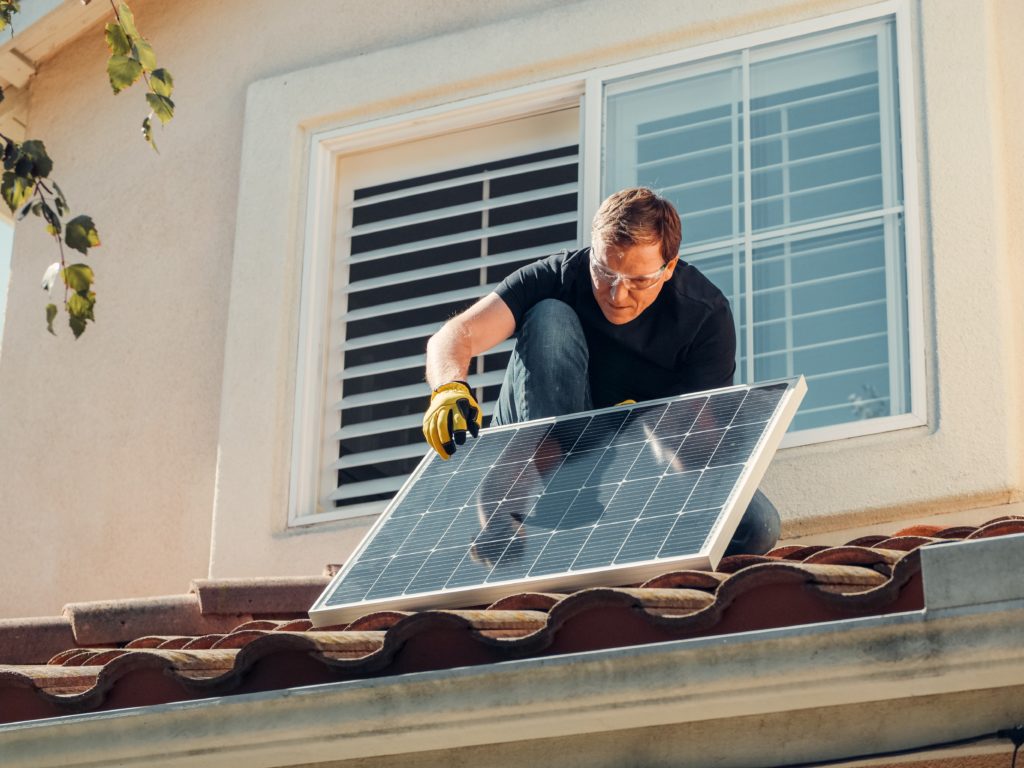
The installation of renewable solutions, as solar panels.
The installation of conventional instrumentation (sensors, actuators and controllers) and intelligent instrumentation (as thermostats or intelligent counters).
Although the fisrt ones are already widely spread between the owners community, in several cases they are not choosen with a endorsed criteria because of the energy and economic savings calculations. Are also not usually applied in a combined way, allowing obtaining more flexibility in the generation and consume of energy (even going as far as self-consumption), mainly if we put into play solutions of energy generation based in renewable sources. At CARTIF we have been investigating and providing solutions to this problem for several years, through the digitalization (based in BIM), automatization and optimization of the design process of rehabilitation solutions in buildings and districts. These thematics are covered in projects such as OptEEmAL or BIM-SPEED.
2. Connected systems and devices
It is not enough with having instrumentation devices or automatization networks in our buildings (including legacy systems or already existent in the house, such as domestic appliances or other informatic systems), but that such devices should be connected to a network such as Internet to make them accessible in a remote way and offer the possibility of exchange information and being controlled. In this domain operates the famous Internet of Things (IoT). Its purpose is to offer the capacity of access to all the devices of the house to be able to collect information about their signal and status, and at the same time could storage those information in persistent and secure means. The information is power, and through the connectivity solutions and the IoT monitorization we will have at our disposal the data about the actual status of our building and with the capacity of making fundamental decisions. This is the base through the achievement of the named “Intelligent Building”. CARTIF, through its projects BaaS,BREASER, E2VENT or INSITER implements several solutions of signal monitorization as a base to the generation of management systems and building control or BEMS (Buildiing Energy Management Systems).
3. Advance strategies for the management, operation, flexibility and maintenance of the building
Once the information about the behaviour and status of the house is in our power, can be raised and develop building control strategies able to react in response to the user needs (reactive building) or even to anticipate the needs of the same (proactive and intelligent building). In this second case, the implementation of techniques and algorithms of Artifical Intelligence, powered by the data previously monitorized, are essential for learning and capture the knowledge both of the behaviour of the building and of their occupants. This will make available services with expert knowledge to be able to control and optimize the behaviour of the building, predicting their possible thermic and electric demand and offering flexibility and storage solutions, or anticipating possible failures of their energy systems, between other possibilities. This puzzle piece is fundamental for the achievement of the “Autonomous and Intelligent Building“, by making the building into an entity capable of making decisions without the intervention of their inhabitants, but learning from their behaviour. The help decision-making and auto-management systems of the buildings are based on intelligent and advance strategies, as it is about covering in projects such as MATRYCS, Auto-DAN or frESCO in which CARTIF take part nowadays.
4. Training and awareness of the users/inhabitants of the building
At last, but not for that reason less important, the user of the building (inhabitant, manager, owner or operator) presents a fundamental role in the fight towards the increase of the energy efficiency. The buildings are created for and to the inhabitants, and guarantee their comfort both thermal, luminic and environmental (ventilation, air quality) is fundamental. But nor just any procedure will do to achieve this welfare. Here is where the user of the building plays a essential role, not only showing their needs and preferences, but also learning good practices and improving their behaviour when using the energy systems, domestic appliances and other devices of their houses. The information that now we collect from the buildings, valorized with the Big Data and Artificial Intelligence techniques, and made available to the user, will allow the user to know how the building behaves, how much CO2 emits and what it costs to achieve welfare. Put in full context, the user could improve the way we operate and live in their houses, promoting the efficient use of the energy systems that are under their control. CARTIF projects such as SocialRES and LocalRES tries to involve the citizens through the energy transition.
The combination of all these technologies, capable of transforming our buildings in ones more intelligent and proactive, and our users into trained and informed interveners, will make our building stock more efficient and sustainable.
All of the above is focused in reaching that our buildings, mainly the already existent, could behaviour in a more efficient way, and that they can thereby contribute to reducing energy use.
But, what happens if despite of our effort we are not able to reduce the CO2 emissions and other green house gases?
The reality as od today is that the global temperature of the planet continues increasing and the expected climatic pact still seems far from being achieved. As a consequence, we have not only to focus our investigation efforts, as we have been doing in CARTIF, in which our buildings consume less energy, and thus less CO2 and other green house gases is emitted for their production, but in new architectural designs capables of coping with extreme climatic conditions, that is, hotter summers, colder winters, more abundant precipitations… The future houses should therefore be well insulated, being self-sufficient in generation-consume of energy, being capable of manage and drain more water, and including green solutions. We cannot ignore this challenge in the not too distant future.